American Generation 1
Johann George Bernhard Kessler (1711–1792)
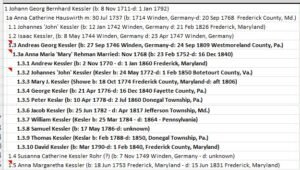
Johann George Bernhard Kessler (George Bernhard), son of Hans Nicholaus and Anna “Barbara” Zittel Kessler, was born on Nov 8, 1711, in Winden, Germany. He married Anna Catharine Hauswirth (b: 1714 Winden, Germany-d: 20 Sep 1768, Frederick, Maryland) on 30 Jul 1737.
George Bernhard’s father, Hans Nicholaus, died in 1720 at the age of 58. His mother remarried to Charles De la Hai, Jr., who was manager of the Zweibruecken Compound in Winden, Germany. This accounts for most baptismal sponsors of his children being of that association. Many French and Swiss (foreigners) took on these positions since the local populace had their own businesses and farmers. Being the youngest of many children, George Bernhard didn’t have much to inherit, so it is understandable that he determined to immigrate to America for a better future.
HISTORICAL CONTEXT: COLONIAL AMERICA AND FREDERICK, MARYLAND
The history of early German settlement in western Maryland begins to the north in Pennsylvania. In 1671, William Penn and his emissaries traveled to the Netherlands and German states encouraging people to immigrate to the colony of Pennsylvania. Due to Penn’s efforts and England’s liberal colonization policies, massive waves of German immigrants flooded into Pennsylvania and New York. By 1730, 20,000 Germans had arrived in Pennsylvania. Rapid growth within the colony meant most new immigrants could not afford skyrocketing property prices. Many German immigrants came to Pennsylvania as manumitted servants, had little income saved to buy land, so they began venturing west and south where the prospects of securing property seemed more promising.
Settlement of the land that was to become Frederick County Maryland was encouraged in 1730 by an offer made by Lord Baltimore of 200 acres free from quit rents for 3 years to persons establishing residency.
A 7,000-acre parcel of real estate in Western Maryland was surveyed on April 15, 1725 for Benjamin Tasker, president of the Governor’s Council of Maryland. On June 7, 1727 he received a patent for those 7,000 acres and he named the tract Tasker’s Chance. On May 10, 1739 Benjamin Tasker presented the first of numerous petitions to the Maryland Assembly seeking the establishment of a new county to be carved from Prince George’s County. Frederick County was created in 1748 and included all of present-day Montgomery, Frederick, Washington, Allegheny and Garrett counties.
Frederick Town was laid out and included the 7.000-acre track known as Tasker’s Chance. The City of Frederick was established in 1745. By 1755 Frederick Town was the most populated county in the state of Maryland.
Understanding this history is important because it relates in many ways to the background regarding Kessler immigration and settlement in the Frederick area.
WHY DID JOHANN GEORGE BERNHARD KESSLER IMMIGRATE TO AMERICA?
One of the key genealogical questions for generations that migrated is: “Why did they decide to give up their home and family and move to a new location?” There are no specific records that explain the thinking process, so we have to use various factors to surmise what occurred.
A primary catalyst for leaving was conditions in Germany prior to 1751. By 1750 there was a wave of mass migrations from the “Palatine” (Pfalz) region of Germany where Zweibruecken and Winden were located. Germany was not a united country but made up of many kingdoms, duchies, knightly estates, margraves, etc. Each had its own laws and record keeping methods. Smaller German states such as Zweibruecken were generally characterized by political lethargy and administrative inefficiency, often compounded by rulers who were more concerned with their own personal issues and well-being than with governance and affairs of state. Many of the German city-states were run by bishops, who in reality were from powerful noble families and showed scant interest in religion. None developed a significant reputation for good government.
This period was an era of change in central and southern Germany. Many areas had been devastated during the 30 Years’ War (1618-1648) and the subsequent War of Louis XIV (1688-1697). The areas hit hardest were those bordering France and along the Rhine River including Rhineland, Pfalz, Baden, Hessen which include the region where the Kessler family lived. As a result of these factors many towns were partially or completely depopulated and new settlers had to be recruited to re-settle from France, Switzerland, and other parts of Germany. As these villages slowly rebuilt and began to flourish again, the population quickly increased and within two generations there was an overabundance of workers, many of whom had little chance to own land or be employed.
Mass migration occurred both for reasons related to issues in Germany (push factors) such as worsening opportunities for farm ownership, religious persecution, and military conscription and the economic emergence of the British colonies offering better economic conditions, land ownership and religious freedom.
FAMILY ALREADY ESTABLISHED IN THE COLONIES
In the case of George Bernhard and family another potential reason was that some of his family had already emigrated from Germany to the colonies and likely corresponded about their experiences and the economic opportunities. It is also possible that George Bernhard made one or more trips to America to visit his relatives before making the final decision to relocate.
George Bernhard’s second cousin, Frantz Weiss, was the oldest son of Jacob Weiss and Anna Margaretha Kessler. Frantz was born in 1705, married Marie Barbara Traut in January 1733, and along with his brother Abraham and Abraham’s family, arrived in Philadelphia in the British colony of Pennsylvania aboard the ship Elizabeth on August 27, 1733. He was listed as a blacksmith on the ship’s manifest.
The families settled in Lancaster, Pennsylvania and were later followed to America by two other brothers, Hans Peter and David Weiss. Frantz’s name appears in a list of those present at a baptism at the Muddy Creek Lutheran Church in Lancaster, Pennsylvania in 1739.
Note from the Church history: Probably 1732 or 1733 the congregations built a log church to worship in, one without a floor. During the cold weather in winter, logs were placed in the center of the church with a bonfire to keep warm, while the early pioneer pastors preached. It was necessary for a few men to keep watch with firearms in case of Indians. For the next 200 years under the leadership of devoted pastors these two congregations flourished both spiritually and numerically.
Within a few years of arriving in Pennsylvania, the Weiss’ relocated 90 miles south of Lancaster to a settlement named “Tasker’s Chance.” Frantz appears as Francis Wise on a list of Tasker’s Chance settlers who were naturalized in Maryland on May 3, 1740. Benjamin Tasker was the original owner of Tasker’s Chance. He listed Frantz Weiss along with 5 other Germans as persons trying to buy all of the Tasker’s Chance tract on June 11, 1737.
The fact that his second cousins had already emigrated likely made it easier for George to envision that he could successfully leave Germany and settle in America with his family.
IMMIGRATION TO AMERICA AND SETTLEMENT IN JEFFERSON TOWNSHIP
At the territorial archives in Speyer, Germany, located about 20 miles northwest of Winden a handwritten document authorizing the 1751 immigration of our direct family line to America was located. It reads:
“Catharina Kessler, maiden name Hauswirth, of Winden, is traveling with her husband and four children to America.”
The document pertains to villages in the Zweibruecken Duchy. George Bernhardt Kessler is not mentioned by name likely because all fixed assets owned by the family were in his wife’s name. She had acquired these by inheritance.
Johann George Bernhard Kessler and his family traveled 275 miles northwest from Winden, Germany to Amsterdam, Netherlands in 1751. He and Catharina and three children accompanied by Catharina’s 25-year-old brother Johann Jacob Hauswirth sailed to America on the ship Janet, arriving on October 5, 1751. The children were Johannes, Andrew “Andreas,” and Susanna. One child, Isaac, died in 1747 before the family immigrated. Another, Margaretha, was born in Maryland in 1753. They then traveled to Frederick, likely accepting the hospitality of his second cousins.
George Bernhard and his family appear in church records until 1789. There are Frederick muster rolls from approximately 1757 that suggest that he may have served time with the Hessian Army. Other records suggest that he fought Indians in Frederick, Maryland under a Captain Peter Butler. He did not collect what had been owed him for his last days of active duty until 1768. He owned land in Tasker’s Chance, now Frederick, Maryland and was naturalized in 1759 in Annapolis, Maryland.
1751 to 1789 Life in Jefferson Township, Frederick County, Maryland
The American colonies were prospering, and their combined population exceeded 1.5 million by the time the Kessler family started farming in Jefferson Township. Frederick was heavily populated by German immigrants. It was possible to attend churches where services were conducted entirely in German and to interact with many who also spoke the language.
When the family arrived in 1751, Johannes was nine years old and Andreas was seven years old. As Johann began clearing land and operating his farm, his two sons likely spoke German and helped their father with farm chores and activities.
Major historical events that would shape the future of their new country were happening during the second half of the 18th century, but it is likely that the family’s location in the countryside outside of Frederick Town, limited understanding of the English language, and the challenge of establishing an economically viable farm consumed most of their time, effort, and attention.
The French and Indian War raged along the Appalachian mountain frontier and beyond from 1754 until 1763. The French had constructed a series of forts from Canada to what is now Pittsburgh and, with their native American allies, were destroying settlements, killing settlers and threatening the American colonies. Much of this fighting occurred in western Pennsylvania where Andreas and his family would relocate several decades after the end of the French and Indian War.
Events during the 1760s, as Johannes and Andreas grew to adulthood, set the colonies on a path to revolution. George III ascended to the throne in 1760 and appointed political leaders who favored a stricter policy toward the American colonies. This resulted in passage of the Sugar Act in 1764 and the Stamp Act and the Quartering Act in 1765. By mid-1765, colonial activists and political bodies were actively protesting “taxation without representation” and the protests grew violent. While the Stamp Act was repealed in 1766, the Townshend Acts were enacted in 1767, imposing duties on glass, tea, and other items imported into the colonies. The Americans reacted by adopting non-importation agreements and refusing to buy British goods. Formal and informal protests and objections continued through the remainder of the 1760s. The stage was set for the events that followed in the 1770s.
The 1760s were likely a time of prosperity and economic success for the Kessler family as their farm matured and the colonial economy expanded. Andreas and Anna Marie Rehman married in October 1768, and it is likely that older brother Johannes married during this decade as well.
The 1770s were a time of revolution and no matter what level of isolation existed on the Kessler farm, family members likely closely followed unfolding events whenever they had occasion to travel into Frederick Town. The Boston Massacre occurred in March 1770, setting off a series of events leading to the rebellion that was fueled in 1775 with the Battles of Bunker Hill and Breed’s Hill. The colonies signed the Declaration of Independence in 1776 and the Revolutionary War raged over the next seven years, culminating in Cornwallis’ surrender at Yorktown in 1781 and the signing of the Paris Peace Accord whereby Britain recognized the United States as an independent nation.
Little is known about the Kessler views on the revolution and their loyalties to one side or the other. There is some evidence that Kesslers were involved in some of the Revolutionary War activities, but it seems that for the most part, the family continued to operate the family farm and avoid conflict during the revolutionary period.
As they grew to adulthood, brothers Johannes (John) and Andreas purchased some of their father’s land and some land for their farms on the edges of what is now called Jefferson, Maryland, 12 miles south of the City of Frederick.
Family Status Based on 1790 U.S. Census
The 1790 US Census for Frederick County recorded the head of household name, and the number of family members based by age category: males under 16, males 16 and older, females, slaves, and total family members. In that census, there are five entries that are relevant to our genealogy, with numbers listed according to this census sequence — males under 16, males 16 & older, & females:
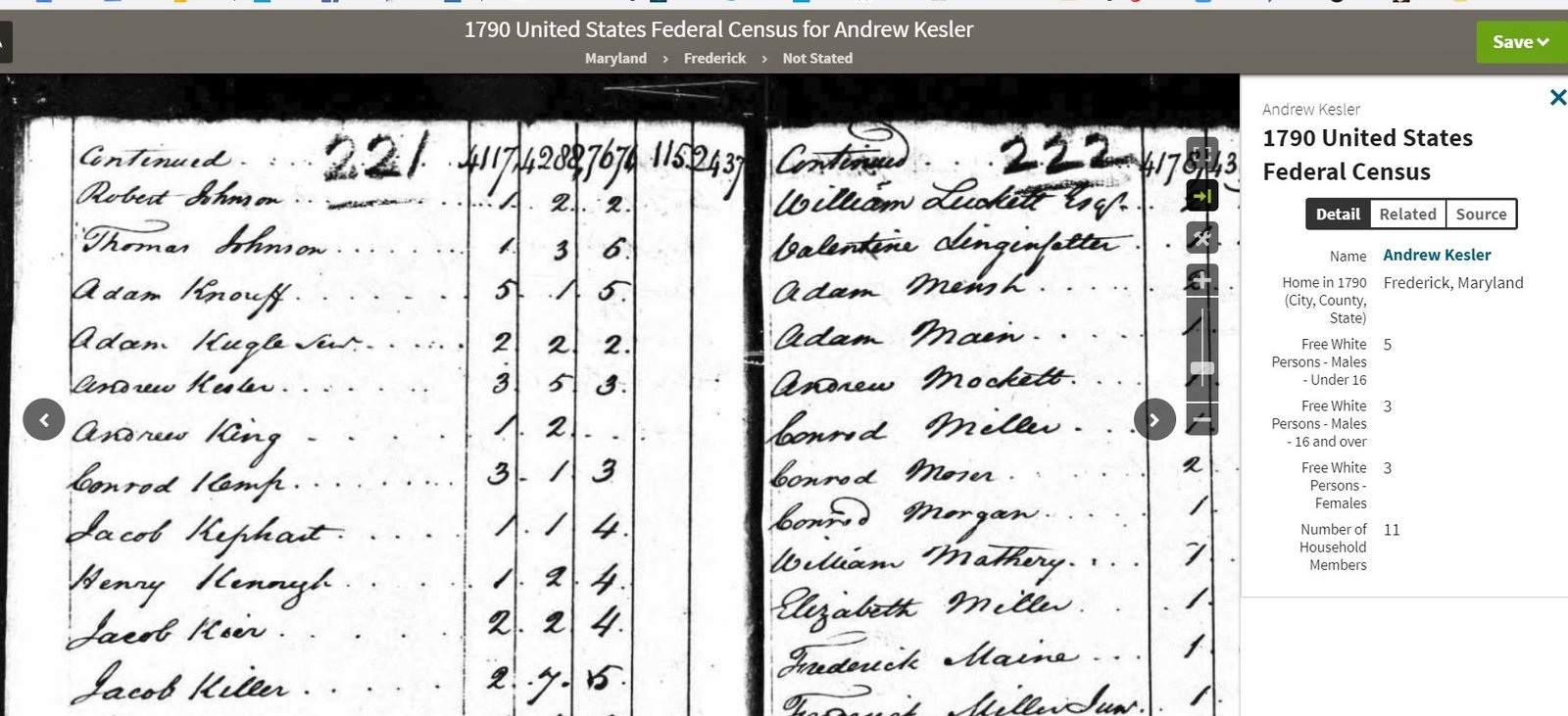
- Andrew Kesler (Frederick County p. 34) — 5, 3, and 3
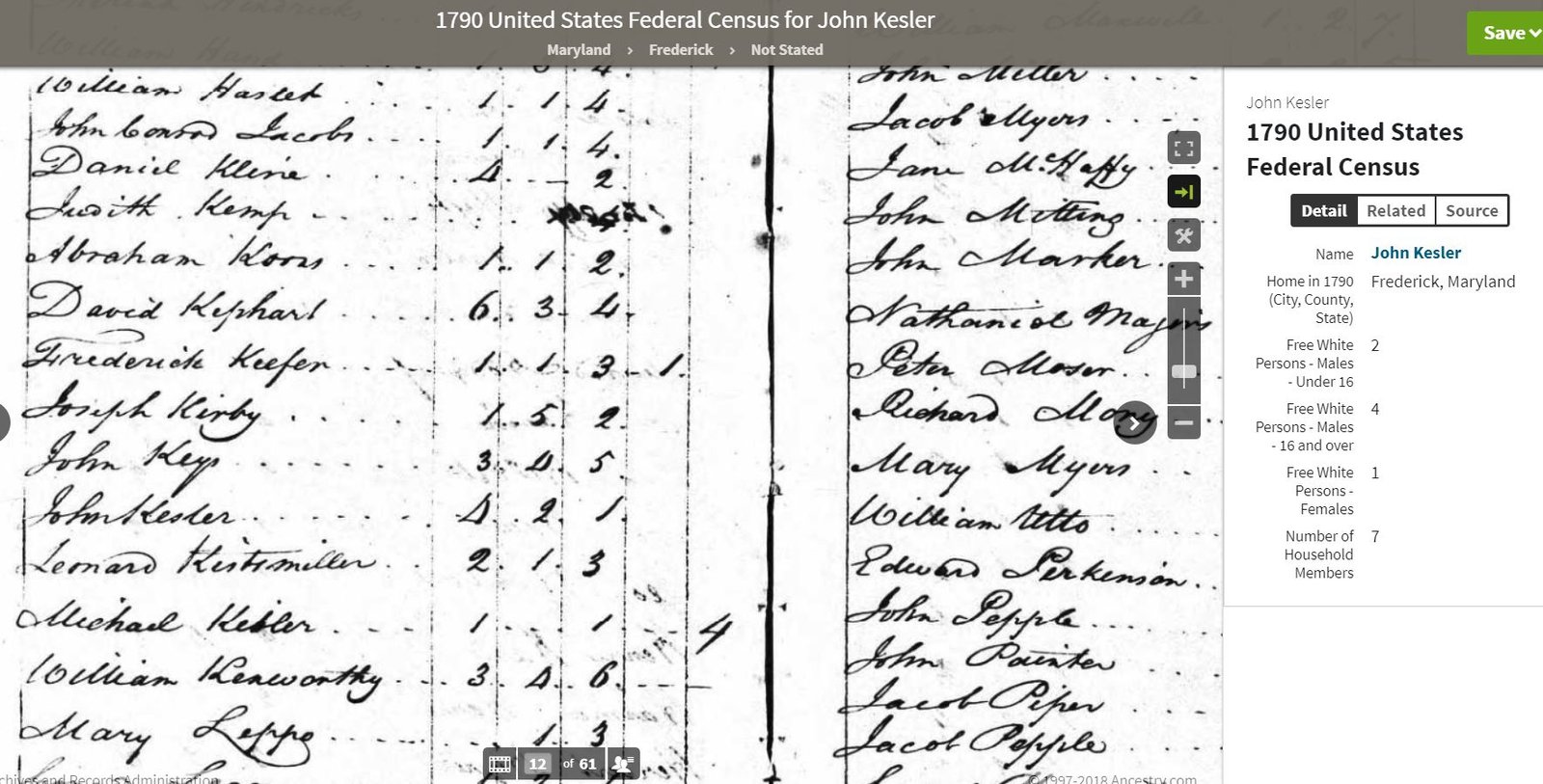
- John Kesler (Frederick County p. 12) — 2, 4, and 1
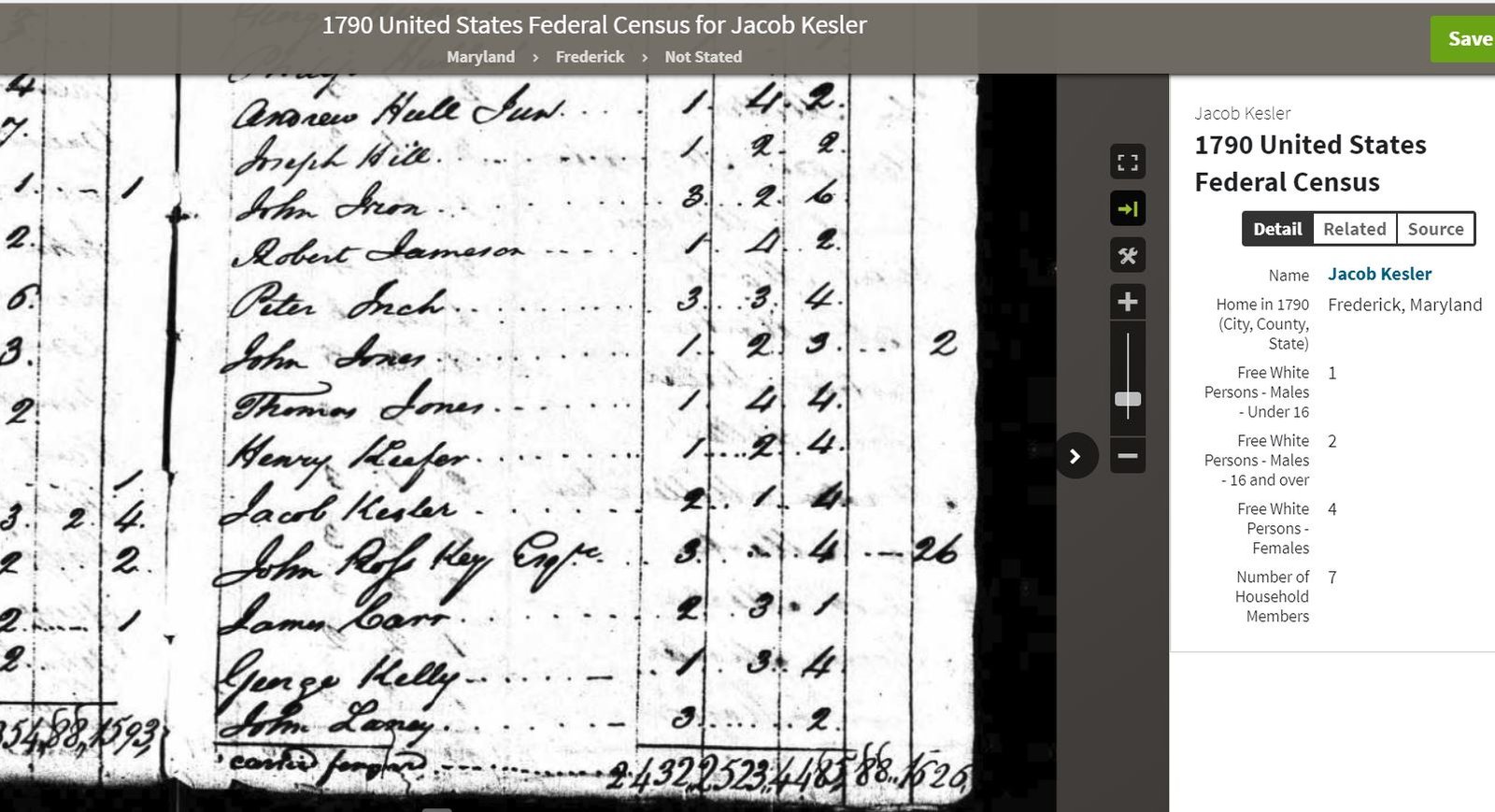
- Jacob Kesler (Frederick County p. 20) — 1, 2, and 4
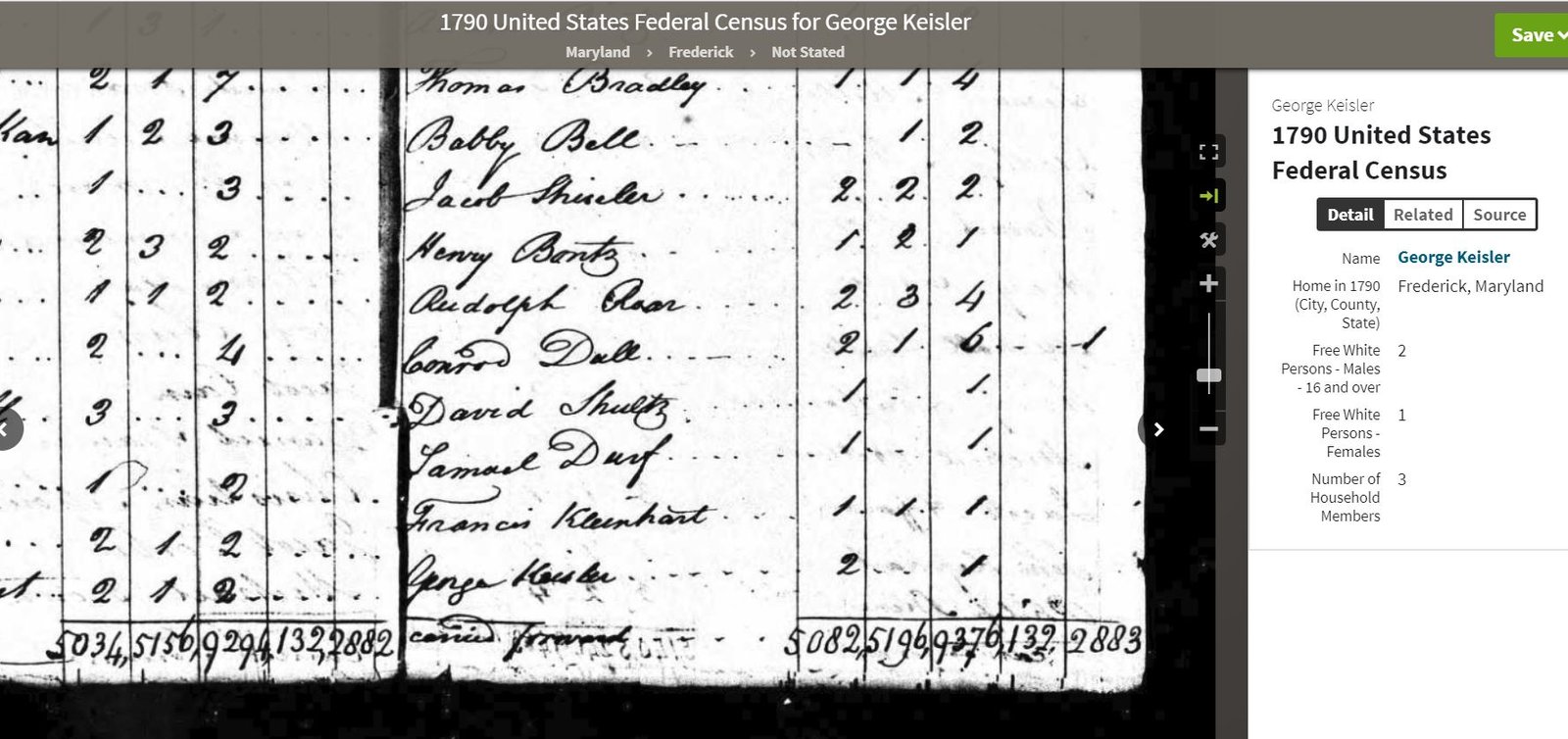
- George Keisler (Frederick County p. 41) — 0, 2, and 1
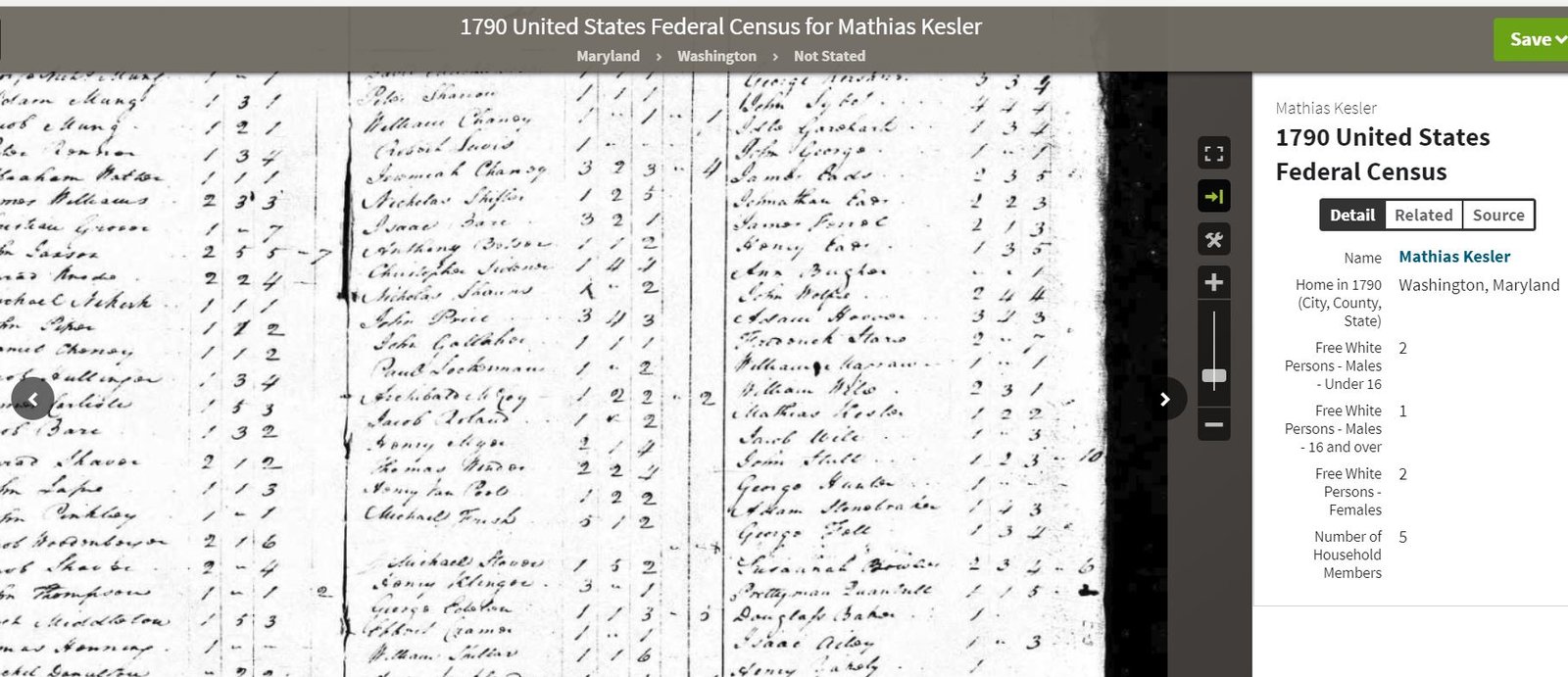
- Mathias Kesler (Washington County) — 2, 1, and 2
It is important to remember that John and Andreas’ father, Johann Georg Bernhardt was 78 years old and still alive in 1790. He did not die until 1792, so he was likely living with one of his two sons or with his daughter Anna. It is likely that the Andrew Kesler and John Kesler entries in the US Census were the two brothers.
We have little information about Andreas’ brother John (birth name Johannes). We know that he was born in January of 1742, came to America with his family, and died in Feb 1826 in Frederick County, Maryland. One record was located with his name – a christening for a daughter, Anna Maria Kessler, dated November 16, 1766 at Evangelical Lutheran of Middletown, Frederick, Maryland. Her parents are listed as Johannes and Catharina Kessler. This is important, because there are some significant issues that cannot be reconciled unless we accept the premise that John parented children during the 1760s.
Another possibility is that Jacob, George and/or Mathias are relatives that followed Johann and his family from Germany, locating to Frederick County because of the family relationship.
The entry for Andrew, as suggested earlier, is probably Andreas who was 45 at the time of the census. His children align with the counts of the others in the household, for the most part. In addition to Andreas (age 45), there was his sons Andrew (age 20) & John (age 18) to account for the three males age 16 and older. Males under age 16 were likely George (age 14), Peter (age 12), Jacob (age 8), William (age 6), and Thomas (age 2). Females included Anna Maria (age 38) and Mary (age 16). The identity of the third female is uncertain — possibly a wife of Andrew or John.
Since there are only five male children under the age of 16, we have to speculate regarding why that number is not seven. Andrew had a son Samuel who was born in 1786, but there is no later record of him so perhaps he died before 1790. Also, infant David was born in March 1790, and should have been counted, but perhaps he was not included for some reason.
Jacob Kesler. listed in the 1790 census, does not appear in the 1800 U.S. Census in Frederick, Maryland. The 1800 U.S. Census includes entries for Andrew Kesler, John Kesler, George Kesler, and Mathias Kesler (last name spelled Kesler rather than Keisler as it was in the 1790 census) residing in Maryland. We will consider the implications of the 1800 U.S. Census later in this narrative.
Andrew Kesler — 1790 US Census
John Kesler — 1790 US Census
Jacob Kesler — 1790 US Census
George Keisler — 1790 US Census (appears as George Kesler in 1800 US Census)
Mathias Kesler — 1790 US Census (resided in Washington County, Maryland)
American Generation #1
Johann George Bernhard Kessler Wife and Children
Johann George Bernhard Kessler b: Nov 8, 1711, Winden, Germany d: Jan 1, 1792, Frederick, Maryland
Anna Catharina Hauswirth Kessler b: 1714, Winden, Germany d: Sep 20, 1768, Frederick, Maryland
— married on Jul 30, 1737
Children:
- Johannes (John) Kessler b: Jan 12, 1742, Winden, Germany d: Feb 21, 1826, Frederick, Maryland
- Isaac Kessler b: May 8, 1744, Winden, Germany d: Apr. 23, 1747, Winden, Germany
- Andreas Kessler b: Sep. 27, 1746, Winden Germany d: Sep. 24, 1809, Frederick, Maryland
- Susanna Catharina Kessler b: Nov 7, 1749, Winden Germany
- Margaretha Kessler b: Jun 18, 1753, Frederick, Maryland d: Jun 15, 1831, Frederick, Maryland
MATERNAL ANCESTRY: HAUSWIRTH/BECHTOLD
Anna Catharine Hauswirth was the daughter of Johannes Hauswirth and Anna Margaret Bechtold. She was born in 1714, also in Winden, Germany. Her Hauswirth family, on the female side had also resided in Winden prior to 1600 even though the Hauswirth male line did not emigrate from Switzerland until the early 1700s. The Hauswirth family resided in Saanen, Bern, Switzerland from at least the early 1500s until Johannes Hauswirth, Anna Catharine’s father emigrated from Switzerland to Winden, Germany.
Anna Catharine’s Paternal Heritage: Hauswirth Family
- Anna Catharine Hauswirth (Kessler) b: 1714, Winden Germany d: Sep 20, 1768, Frederick, Maryland
- Johannes Hauswirth b: Jun 25, 1682, Saanen, Switzerland d: May 17, 1726, Winden, Germany (Married Anna Margaret Bechtold)
- Benedict Hauswirth b: Aug 20, 1643, Saanen, Switzerland d: 1711, Saanen, Switzerland (Married Anna Annen)
- Balthasar Hauswirth, Jr. b: Jul 24, 1614, Saanen, Switzerland d: 1680, Saanen, Switzerland (Married Anna Jaggi)
- Balthasar Hauswirth b: Feb 13, 1577, Saanen, Switzerland d: aft. 1614, Saanen, Switzerland (Married Magdalena Fleuti)
-
Simon Hauswirth b: 1537, Saanen, Switzerland d: 1537, Saanen, Switzerland
(Married Benedicta Von Siebenthal)
Note: In some genealogical trees, Hauswirth is spelled Hauswurth.
Next Page — Ch 3 – Immigration & Homesteading